
xlog run via EIR → GPU-executable
plan and execute Generate-Propagate-Test on the GPU. The production acceptance
evidence covers GPU/WCOJ execution, nonzero tuple-key membership, solver production
reuse, probabilistic production reuse, and legacy compatibility.
This guide describes the semantic layer and the GPU runtime/production-reuse
behavior. The fixtures and CPU oracles referenced throughout are the test/reference
surface; the shipped evidence is the production GPU path.
Execution Path
Accepted epistemic programs route throughxlog run via EIR → GPU-executable
plan and execute Generate-Propagate-Test on the GPU. EIR-routed xlog run is
the accepted execution path. Raw RIR lowering of bare modal literals is still
rejected with UnsupportedEpistemicConstruct (a typed diagnostic); accepted
epistemic execution always goes through the EIR boundary, not direct RIR
lowering.
plan_epistemic_gpu_execution builds the GPU execution contract from parsed
AST/EIR. That contract records required GPU phases, GPU-resident buffer
categories, WCOJ planner obligations for eligible reduced ordinary bodies, and
zero CPU fallback counters.
compile_epistemic_gpu_execution adds the production-lowering step after the
GPU contract is built. The stats-aware
compile_epistemic_gpu_execution_with_stats_snapshot variant forwards
StatsSnapshot into the normal compiler pipeline, including optimizer passes,
helper splitting, and WCOJ promotion. This produces the lowered route and WCOJ
planner surface for eligible reductions, feeding the Generate-Propagate-Test
kernels and world-view validation that follow.
xlog-runtime also exposes EpistemicGpuWorkspaceLayout and
Executor::allocate_epistemic_gpu_workspace, which map the plan contract to
device-buffer allocations for candidate assumptions, world views, model
membership, and rejection reasons. EpistemicGpuRuntimePreflight consumes an
EpistemicExecutablePlan, computes the workspace layout, rejects nonzero CPU
fallback counters, and records WCOJ route/helper metadata before launch.
The executor drives the pipeline through a sequence of CUDA kernels, each
recording a trace with one kernel launch, zero host writes, and CUDA-event
elapsed timing: workspace reset (prepare_epistemic_gpu_execution), candidate
generation, propagation, candidate-buffer validation, tuple-source model-membership
staging, world-view validation, accepted-candidate materialization, final-result
flag staging, and membership-gated final tuple materialization.
Model membership is staged over existing GPU relation buffers with row-scoped
ground-key comparison through specialized arity-one/two/three kernels and a
generic arity-N kernel, plus row-scoped variable-bound comparison against
reduced-output columns. Ground tuple keys are encoded as expected raw bits plus
scalar type codes and compared against relation-cell bytes on device. Anonymous
keys, aggregate keys, and full semantic parity still fail closed.
World-view validation reads the candidate-assumption matrix as the semantic
boundary and rejects a candidate unless every required epistemic literal has
tuple-source support in the model-membership buffer. The final-row map kernel
filters output rows by accepted membership, world-view state, all variable-bound
tuple-key relation matches, and binding polarity before the final tuple kernel
compacts reduced output columns.
Executor::execute_epistemic_gpu_execution wraps the reduced production
runtime plan with preflight, workspace allocation, candidate generation,
propagation, candidate validation, execute_plan with before/after counter
tracing, then the membership, world-view, and materialization staging kernels.
It also snapshots provider host-transfer counters around the hot path and records
EpistemicGpuTransferBudgetTrace, which rejects tracked data-plane host-to-device/device-to-host
deltas instead of resetting shared telemetry.
The shipped acceptance surface is bounded. Outside that surface, arbitrary-world
enumeration and additional solver/probabilistic coverage remain future scope;
within it, accepted runtime evidence feeds the solver and probabilistic production
adapters described below.
GPU And WCOJ Scope
The shipped execution path is GPU-native for the supported surface and exercises the production GPU/WCOJ stack:- WCOJ planner eligibility and runtime dispatch are observed for an accepted
existing 4-cycle
MultiWayJoinreduction, and layout, skew-aware scheduling, helper-splitting specs, helper relation rewrites, and runtime histogram metadata are observed for accepted K5/K6/K7/K8 epistemic reductions. - Candidate generation, propagation staging, candidate-buffer validation, tuple-source model-membership staging, world-view validation, accepted-candidate materialization, final-result flag staging, final-row map construction, and membership-gated final tuple materialization use GPU workspace/output buffers with zero CPU candidate/world-view fallback counters.
- Unary and binary nonzero-arity
know/possible/not possibleslices, binarynot know, quaternary generic arity-Nknow, unarynot know, multi-membership combinations, split operator components, Gelfond 1991 compatibility self-support, and independently founded FAEEL fixtures compare bounded GPU traces against semantic or GPT oracles. - Solver SAT/UNSAT, lifecycle, split-batch learned-clause, MaxSAT, weighted MaxSAT encoding, scheduler, and portfolio paths route accepted GPU evidence into existing GPU CDCL/CNF adapter paths.
- Probabilistic source/program compile, condition, PIR/CNF encode, query, and gradient paths route accepted GPU evidence into existing GPU exact/provenance paths.
Prior Goal Reuse
The released epistemic runtime reuses prior infrastructure only at the boundaries the runtime actually touches:- Existing WCOJ runtime: reuse the general WCOJ architecture and runtime
expansion, including first-class
RirNode::MultiWayJoin, deterministic 4-cycle dispatch, recursive/SCC support, and variable-ordering/cost surfaces. - K-clique WCOJ implementation: reuse the production K-clique WCOJ path:
MultiwayPlan,KCliqueVariableOrder, sorted-layout requirements, runtime histogram metadata count/timing, cost-gated hash routing, skew scheduling, and helper-splitting specs. - Chain-dispatch and replay infrastructure: reuse the existing production substrate for chain dispatch, K7/K8 templates, sort labels, DLPack/zero-transfer discipline, CUDA Graphs, and external consumer replay certification only when the epistemic runtime path actually invokes those surfaces.
MultiWayJoin metadata plus K-clique
route metadata and fails closed when a WCOJ-required non-hash MultiWayJoin or
K-clique reduction lacks production counter deltas. It certifies accepted
4-cycle plus K5, K6, K7, and K8 WCOJ dispatch through production runtime
counters. Non-K-clique epistemic reductions must pass through
RirNode::MultiWayJoin and the existing production dispatch counters; K-clique
epistemic reductions must pass through MultiwayPlan, KCliqueVariableOrder,
sorted-layout requirements, and helper-splitting specs rather than a parallel
epistemic WCOJ planner. The plan contract also records one
EpistemicTupleMembershipBinding per epistemic literal so runtime preflight can
reject plans that cannot identify the reduced stable-model tuple predicate to
check.
Future work broadens the shipped surface:
- broader EIR runtime dispatch into executable GPU plans beyond the supported surface;
- WCOJ planner eligibility, layout construction, skew scheduling, and helper splitting beyond the current 4-cycle and K-clique coverage;
- broader GPU-native SAT/MaxSAT/portfolio solving and probabilistic-epistemic evidence coverage (the current adapters are real but bounded);
- a device-resident, no-host-interaction WFS path (the shipped GPU-backed WFS is host-orchestrated and may read metadata row-counts).
World-View Boundary
EpistemicWorldView is the explicit semantic boundary object. It is a non-empty
set of accepted stable models. Over a world view:
| Operator | True when |
|---|---|
know p/arity | p/arity appears in every world |
possible p/arity | p/arity appears in at least one world |
not know p/arity | know p/arity is false |
not possible p/arity | possible p/arity is false |
EpistemicWorldView values are the CPU reference/test
surface used to check that GPU path.
Epistemic Source Surface
The accepted source forms are:know/possible
chains with leading, interior, or atom-adjacent negation, then normalizes by
parity and duality before GPU execution: know possible p() becomes
possible p(), know not possible p() becomes not possible p(), and
know possible not p() becomes not know p(). The EIR boundary is exposed
through xlog_logic::build_eir, which preserves epistemic literals as
EirBodyLiteral::Epistemic.
Gelfond 1991 Compatibility
Gelfond 1991 compatibility mode is selected explicitly with:possible p/arity succeeds when p/arity is
either known or compatibility-possible. Non-epistemic programs remain isolated:
the same non-epistemic source lowers to the same RIR under default mode and
Gelfond 1991 compatibility mode.
A GPU runtime fixture runs explicit #pragma epistemic_mode = g91 with
p() :- possible p()., loads the reduced nullary fact through the existing
relation-buffer path, validates stable tuple-source membership, accepts one
world view, materializes p(), and records zero CPU candidate/world-view
fallback counters. This is a bounded Gelfond 1991 compatibility runtime slice;
broader compatibility coverage remains future work.
FAEEL Default
FAEEL is the default mode. In the bounded semantic evaluator:know p/arityrequires founded knowledge;possible p/arityalso requires founded knowledge;- possible-only support is rejected as
UnfoundedPossible; - known plus rejected support is rejected as
Contradiction; - otherwise unsatisfied epistemic literals are reported as
UnsatisfiedLiteral.
p() :- possible p(). as unfounded and executes it to the
defined empty founded extension rather than rejecting the program. If p/arity
has separate ordinary support without epistemic body literals, the
self-possible rule is treated as independently founded and may lower into
accepted GPU runtime execution. The same unsupported self-support is accepted
only with explicit #pragma epistemic_mode = g91.
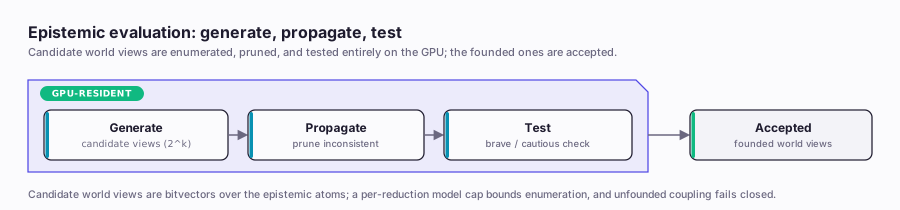
Generate-Propagate-Test
run_generate_propagate_test executes a bounded three-phase reference pipeline
under the default FAEEL semantics. run_generate_propagate_test_with_mode uses the same
pipeline with an explicit semantics mode, including Gelfond 1991 compatibility checks:
- generate: accept an explicit candidate list and enforce
max_candidates; - propagate: prune immediate known/rejected contradictions;
- test: evaluate remaining candidates under the selected bounded semantics.
EpistemicGpuSemanticTrace after the
hot-path transfer-budget window. That trace reads bounded rejection-reason
metadata from the device buffer and reports generated, guess, propagated,
pruned, tested, reduced-model-slot, accepted-world-view, rejected-candidate,
accepted/rejected candidate indices, and rejection-reason counts with zero CPU
candidate enumeration and zero CPU world-view validation counters.
EpistemicGpuRejectionReason decodes nonzero device rejection codes so bounded
GPU traces can be compared with the GPT oracle’s phase counts,
accepted/rejected candidate indices, and typed rejection expectations.
Multi-membership fixtures compare same-rule candidate matrices against bounded
GPT oracles for all-know membership, mixed know/possible membership,
negated not know/not possible membership, and the all-operator matrix. Unary
and binary nonzero-arity fixtures across every operator, plus a quaternary
know fact4(A, B, C, D) fixture exercising the generic arity-N bound-output
tuple-key path, compare the same trace and candidate-index fields against bounded
GPT oracles. Full semantic parity across every Gelfond 1991 compatibility, FAEEL,
Generate-Propagate-Test, and splitting case remains future work.
Epistemic Splitting
split_epistemic_program builds deterministic components from source rules. It
no longer rejects a rule that couples more than one distinct epistemic body
predicate: such a rule’s modal predicates are unioned into a single component
solved jointly as a full modal conjunction over the candidate world view. For
accepted split fixtures, recomposed_rule_indices() must recover the original
source rule order.
Integration coverage pins the joint-solving contract with a multi-membership
know edge(X)/know color(X) fixture in a mixed program with possible alt(X)/not possible blocked(X),
accepting it as two independent joint components (per-rule joint semantics
verified on device). Same-name multi-arity coupling now disambiguates by
arity-qualified tuple sources (p/1, p/2) and is exercised by a production
xlog run base example plus an exhaustive same-name multi-arity matrix.
Genuinely cyclic modal coupling with no founded or WFS evaluation order still
fails closed with a typed diagnostic rather than being solved.
compile_epistemic_gpu_split_execution lowers valid epistemic split components
through compile_epistemic_gpu_execution_with_stats_snapshot, producing one
GPU executable subplan per epistemic component. This reuses the same reduced
runtime compiler, WCOJ promotion, and helper-splitting surfaces as unsplit
epistemic execution. Executor::execute_epistemic_gpu_execution_batch executes
component executable plans in order by delegating each item to the existing
single-plan GPU runtime path. The traced wrapper
Executor::execute_epistemic_gpu_execution_batch_with_trace returns
EpistemicGpuBatchExecutionTrace, which aggregates component executions,
accepted/rejected counts, zero CPU recomposition steps, zero CPU
candidate/world-view fallback counters, and zero per-candidate host round trips.
Split runtime coverage also includes binary operator components (independent
possible edge(X, Y) and not possible blocked(X, Y) components over shared
pair/2 input), an all-binary-operator split of four independent components
covering know, possible, not possible, and not know, and the world-view
distinction between absent possible and true not know: split possible edge(X)
and not know edge(X) components over the same absent edge tuple source return
[] for possible_edge and [1, 2, 3] for not_known_edge.
Solver Services
xlog_solve::GpuSolverProductionAdapter is the production-facing solver reuse
adapter for epistemic callers. It is a thin wrapper over the existing
GpuCdclSolver; it dispatches SAT/UNSAT, workspace-backed UNSAT, bounded
weighted MaxSAT candidate checks, MaxSAT search pruning, weighted MaxSAT
selection encoding, heterogeneous MaxSAT scheduler jobs, and bounded SAT/MaxSAT
portfolio jobs through the GPU CDCL path, and exposes zero CPU assignment/MaxSAT
enumeration counters in GpuSolverProductionTrace.
The *_with_gpu_execution_result family accepts an
EpistemicGpuExecutionResult. These gates require stable tuple-source
membership, GPU model-membership, world-view, and materialization traces, zero
hot-path transfers, and non-empty final device output, then dispatch through GPU
CDCL. Batch variants consume GpuSolverProductionBatchExecutionEvidence from
execute_epistemic_gpu_execution_batch_with_trace and validate aggregate
evidence for zero CPU recomposition, zero CPU candidate/world-view fallback,
zero tracked device-to-host calls, and zero per-candidate host round trips
before dispatching each accepted component. Distinct-CNF learned-clause reuse is
rejected before import, incrementing gpu_learned_clause_reuse_rejections while
keeping CPU learned-clause transfer counters at zero.
Accepted GPU candidate evidence preserves the runtime epistemic mode;
GpuSolverProductionTrace counts Gelfond 1991 compatibility and default FAEEL
candidate evidence separately, and records accepted operator-family evidence
counters for know, possible, not possible, and not know.
xlog_solve::production_capabilities reports that GPU CDCL SAT/UNSAT is
available along with the bounded GPU-backed MaxSAT and SAT/MaxSAT portfolio
adapters. GpuSolverProductionTrace::require_production_metric_eligibility is
the automated metric gate: it rejects traces that did not consume accepted GPU
candidate evidence, that have no existing production-path counter, that only
record lifecycle UNKNOWN/TIMEOUT status propagation, or that record CPU
assignment, MaxSAT, or learned-clause transfer counters.
The adapter is a real shipped bounded surface covering same-CNF reuse,
distinct-CNF fail-closed rejection, accepted lifecycle, bounded UNKNOWN/TIMEOUT
propagation, learned-clause reuse, MaxSAT, MaxSAT search pruning, weighted MaxSAT
encoding/search, generalized MaxSAT scheduling, and portfolio evidence with
batch/component counters. The MaxSAT/portfolio/scheduler surface is real and
bounded; broadening the solver portfolio remains ongoing work, and a dedicated
Solver IR (SIR) is planned.
xlog_solve::SolverService provides the bounded CPU reference solver API used by
semantic tests:
assumeandretract_assumptionmodel incremental SAT assumptions;- learned clauses are transferred through
transfer_learned_clauses_toand counted inSolverServiceTrace; - learned clauses derived under active assumptions remain scoped to those assumptions;
SolveInstance::with_weightsgives fixture-scale MaxSAT soft constraints;SolverServiceStatusdistinguishesSat,Unsat,Unknown,Timeout, andOptimal;- GPU portfolio solving is explicitly reported as not implemented for this
fixture facade, while accepted production portfolio evidence is supplied by
GpuSolverProductionAdapter.
Probabilistic Integration
xlog_prob::epistemic records the bounded probabilistic contract:
- accepted world views become probabilistic evidence through
AcceptedWorldViewEvidence; raw unvalidated guesses must not be consumed as evidence; - epistemic assumptions become fixture evidence literals such as
know:rain/0=true; - GPU exact-compilation/XGCF supports fixture-level incremental evidence updates without changing the circuit fingerprint, including replacing stale active evidence when an accepted assumption changes;
- generic Decision-DNNF text, c2d, and miniC2D adapter contracts are
represented as
DesignOnly; conditional_probability_from_logsnormalizes probabilities withEPISTEMIC_PROBABILITY_TOLERANCE = 1e-12.
xlog_prob::epistemic_production::EpistemicProbProductionAdapter is the
production-facing exact-path reuse adapter. It requires
AcceptedWorldViewEvidence, then routes source or parsed programs through
ExactDdnnfProgram GPU exact/provenance compilation and exposes zero CPU-only
probability recomputation counters in EpistemicProbProductionTrace. The
*_with_gpu_execution_result and *_for_gpu_execution_results families build
that evidence from accepted EpistemicGpuExecutionResult records only after
stable-model tuple-source membership, GPU model-membership/world-view/final-result/final-tuple
kernel traces, zero hot-path transfers, and non-empty final device output are
proven. That accepted evidence preserves the runtime epistemic mode so the
production trace can count Gelfond 1991 compatibility and default FAEEL evidence
consumptions separately.
Conditioned variants turn accepted zero-arity and concrete nonzero-arity tuple
assumptions into parsed exact Evidence AST entries before evaluating through
the same GPU exact path. Unary and binary false assumptions from not know are
preserved as false parsed evidence entries and counted separately. The trace
records conditioned-evidence, negative-evidence, and per-operator counters (true
know, true possible, false know / not know, false possible / not possible),
split by source and parsed-program paths. PIR/CNF encode, exact query, and
gradient reuse paths each apply the same accepted runtime boundary before calling
the existing GPU encoder or ExactDdnnfProgram entry points.
EpistemicProbProductionCapabilities reports fixture circuits as disallowed
for production metrics, and
EpistemicProbProductionTrace::require_production_metric_eligibility rejects
traces that lack accepted world-view evidence, lack an existing GPU
exact/provenance/PIR/CNF/knowledge-compilation counter, only record
conditioned evidence facts without a production-path counter, or record
CPU/fixture recomputation. The end-to-end probabilistic-epistemic evidence
path is real and bounded; broadening it remains ongoing work.
Runnable Examples
The example sources live inexamples/epistemic/:
| Example | Path | Covered behavior |
|---|---|---|
| EIR boundary | examples/epistemic/01-eir-boundary.xlog | explicit EIR epistemic literal |
| Gelfond 1991 compatibility | examples/epistemic/02-g91-compatibility.xlog | possible-only support under Gelfond 1991 compatibility |
| FAEEL default | examples/epistemic/03-faeel-default.xlog | founded known candidate |
| Generate-Propagate-Test | examples/epistemic/04-gpt-candidate-filter.xlog | candidate trace counts |
| Splitting | examples/epistemic/05-splitting.xlog | deterministic component recomposition |
Roadmap Status
ROADMAP.md marks the epistemic and solver rows done. The same-process
multi-executor CUDA primary-context item is tracked separately as
future work, as is the device-resident no-host-interaction WFS path and the
planned Solver IR (SIR).