

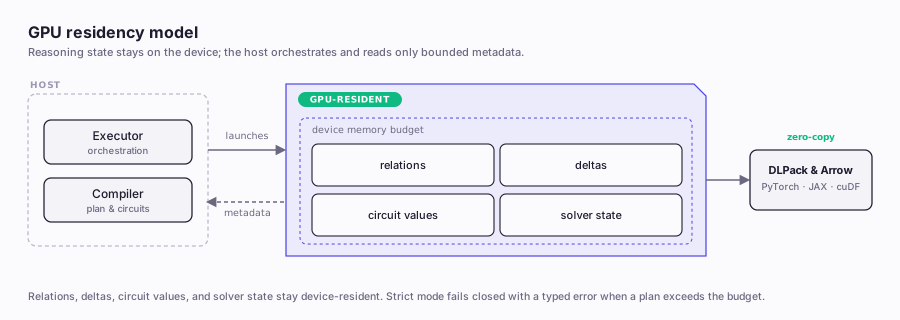
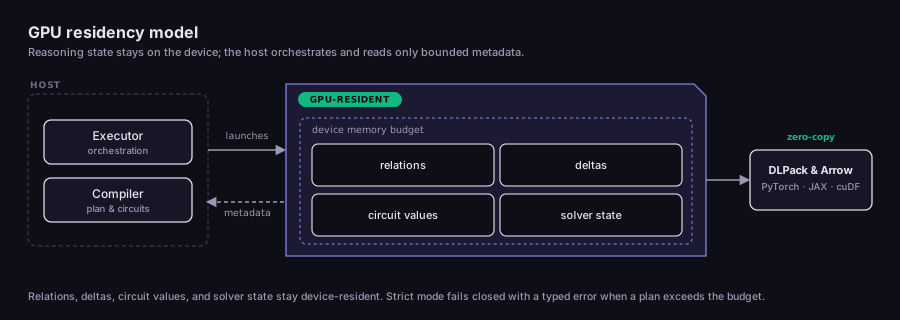
The host launches kernels and reads only bounded metadata; relations, deltas, circuit values, and solver state stay in the device memory budget, and results reach PyTorch, JAX, and cuDF zero-copy through DLPack and Arrow.
The contract
Relations, deltas, probabilistic circuit values, and solver workspaces are represented in GPU memory. The compiler and executor remain on the host: they launch kernels, synchronize streams, and may read bounded control metadata. A zero-transfer claim is therefore a contract of a named execution region, not a property inferred from the words “GPU-resident.”The certified resident conditional-graph core is the strongest deterministic
contract. It permits no tracked data transfer, provider D2H call, or untracked
metadata read while the graph runs. After one terminal synchronization, it copies one
one final pinned receipt containing only status, counts, trace counters, and schema
selections. Relation columns remain device-backed. Other GPU routes are
host-orchestrated and can have different, separately documented observation
boundaries.
tensor.device confirms the final buffer location; it does not prove the
buffer’s transfer history. Use route telemetry and the strict gate below for that
stronger claim.
Enforce it, don’t just observe it
Checkingtensor.device tells you where one result ended up. If you want the runtime to
enforce the contract instead, a Python session can turn on a strict gate:
session.strict_deterministic_d2h_enabled() reports
whether it is on, and session.deterministic_d2h_violation_count() reports how many reads
it has rejected — session.reset_deterministic_d2h_violations() clears that count. A
rejection is atomic: the operation leaves the relation and its evidence unchanged. See the
Python reference for the full API and
diagnostics for a worked zero-transfer audit.
Automatic resident selection
Eligible ordinary query plans use the certified resident conditional graph automatically. If plan certification or preparation declines, automatic mode records the typed reason in execution statistics and runs the existing ordinary GPU route. This is a route decision inside the CUDA engine, not a switch to CPU execution.XLOG_DISABLE_RESIDENT_RECURSION=1 selects the ordinary GPU route explicitly for
answer and timing comparisons. XLOG_REQUIRE_RESIDENT_RECURSION=1 turns any resident
decline into an error. Enabling both is a configuration error.
Bounded memory, capacity, and convergence
Every provider enforces its device memory budget. You can raise the configured limit per program (memory_mb in the API, --memory-mb on the CLI).
If a byte-addressed allocation cannot fit, XLOG does not silently spill or switch to
the host. It fails closed with a ResourceExhausted error. Its fixed-order context reports the rejecting
layer, current reservation, requested bytes, exact required bytes, configured budget,
and the manager’s prior peak. Required bytes are calculated without saturation; if the
exact value exceeds u64, estimated_bytes is u64::MAX and the context carries an
explicit overflow marker. This makes an out-of-memory condition definite and
diagnosable rather than a slow degradation. Count and representational limits use
CapacityExceeded with a unit such as rows, slots, or candidates. Reaching an
iteration bound without convergence uses ConvergenceFailure; neither condition is
reported as byte-memory exhaustion.
Concurrent requests are reserved against the local budget before allocator admission,
so in-flight requests still prevent oversubscription. The manager publishes current and
peak bytes only after admission succeeds: a request refused by CUDA or the device-runtime
budget is removed from the local guard and never appears in the admitted current value or
the reservation-lifetime high-water mark.
Compile once, keep the structure resident
Because the compiled plan is stable across evaluations, XLOG keeps compiled artifacts resident and reuses them. For probabilistic inference this includes the compiled arithmetic circuit: training iterations update leaf weights and evidence in place without recompiling the circuit structure. For deterministic queries, build-side hash indexes for hot relations are cached and reused across evaluations in a session.See it in the pipeline
The compilation pipeline shows exactly where the host/device boundary sits: the
executor orchestrates on the host, while kernels and the relation store are resident
on the GPU.