

For contributors — how XLOG’s GPU execution works internally.
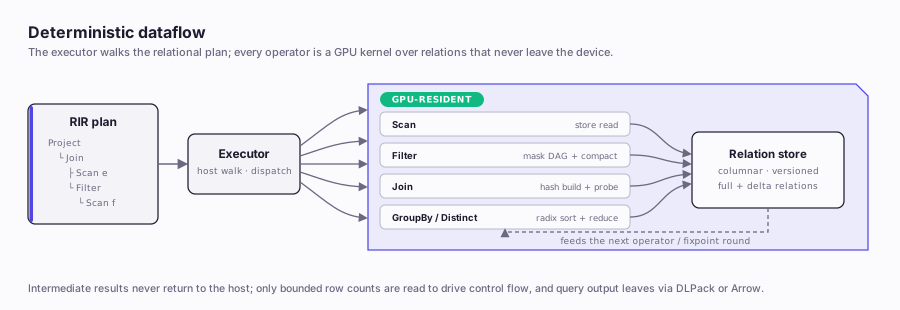
The host executor walks the RIR plan and dispatches one kernel family per operator; relations stay in the device-resident store, which feeds the next operator or fixpoint round (one iteration of the recursive loop, repeated until no new rows appear).
Host Control, Device Data
The split is deliberate: the CPU decides what to run, the GPU holds the data and does the work.xlog-runtime::Executor runs on the host and manages:
- relation names, relation IDs, generations, and schemas;
- a
RelationStorebacked byCudaBuffervalues; - runtime statistics and join-selectivity observations;
- persistent build-side join indexes;
- dispatch counters for optimized routes (per-route counters that record when a specialized kernel actually ran — see What To Verify);
- recursive SCC state for seed, delta, and merge phases. A SCC (strongly connected component) is a group of rules that depend on each other recursively; the runtime evaluates each such group in seed, delta, and merge phases.
xlog-cuda::CudaKernelProvider owns the device-facing operations. It loads CUDA
artifacts, allocates tracked slices, launches kernels, and records transfer
telemetry where a path needs a no-host-transfer assertion.
So the executor itself is not GPU-resident. The relation state and the kernel
workspaces are.
RIR Evaluation
The executor turns each RIR plan operator into GPU work that writes a relation buffer:
“Semi-naive” here means each recursive round processes only the rows newly
derived in the previous round, not the whole relation again.
The correctness rule is row-set parity: an optimized path must return exactly
the same rows as the ordinary route. An optimized path is allowed to decline and
leave the ordinary route selected when a shape, width, budget, or gate does not
match. The decline is recorded; it is not an implicit host implementation.
Predicate And Arithmetic Masks
A filter does not delete rows in place. It lowers into a mask pipeline that marks which rows survive, then compacts them:- Arithmetic expression kernels produce temporary columns.
- Typed comparison kernels produce boolean masks (one bit per row: keep or drop).
- Boolean mask kernels combine predicates with
and,or, andnot. - Stream compaction writes the filtered output buffer.
NaN != NaN). Ordered comparisons use XLOG’s
bit-defined total order: negative NaNs, negative infinity, negative finite values,
-0.0, +0.0, positive finite values, positive infinity, then positive NaNs.
NaN sign and payload make the order deterministic across host and CUDA paths.
Joins And Recursion
The ordinary join is always the baseline path. For certain rule shapes the runtime can route to a faster specialized kernel instead:- hash joins for normal binary joins;
- nested-loop joins for small eligible products;
- WCOJ for recognized triangle, 4-cycle, and clique shapes;
- Free Join for broader multiway bodies;
- factorized recursive-delta routing for recursive rules (a compressed representation of the per-round delta).
Automatic resident recursion
For an eligible ordinary query plan,xlog-gpu certifies the complete
dependency-closed plan and automatically prepares one resident conditional graph.
The graph performs recursive control flow on the device with zero host iterations,
zero allocations in the measured core, and zero tracked or metadata transfers in
that core. After terminal synchronization, the runtime reads one bounded pinned
receipt containing status and counts; output relations stay in device buffers.
If certification or preparation declines, automatic mode records the typed reason
and runs the existing ordinary GPU executor. Required mode turns the same decline
into an error, while disabled mode selects the ordinary executor explicitly.
Every optimized route has its own dispatch counter — for example separate counters
for WCOJ, Free Join, fused aggregate, and factorized-delta. These let you tell “the
answer matched” apart from “the optimized route actually fired,” since the two are
not the same thing.
Ingestion And Diagnostics
Two runtime surfaces sit next to the core evaluation loop rather than inside it: bulk graph loading and delta diagnostics.xlog_gpu::biokg::StreamingGraphRelationLoaderstreams JSONL, CSV, and N-Triples graph rows into typed edge records, with bounded-memory telemetry.DeltaPlannerTelemetryreports cache reuse, route-decline decisions, affected SCCs, recomputed SCCs, and estimated versus measured delta behavior.pyxlogexposes planner telemetry through diagnostic result payloads.
What To Verify
A matching final result does not prove that an optimized GPU route ran — the ordinary route returns the same rows. To prove a workload used the intended GPU path, check:- the route counter for the optimized dispatch (was it greater than zero?);
- kill-switch parity: disable the optimized route and confirm the ordinary route returns the same rows;
- transfer telemetry, for any no-host-transfer claim;
- CUDA-required validation, when the claim depends on actual GPU execution.